dinsdag 2 juli 2013

Exploring the Arctic’s change at Blomstrand glacier

30 June 2013

Captain Wojtek 
© Bas Bolman
For Martine, Ruben and Bas this is the last day at Ny-Ålesund, whereas Ariadna and Ben are staying for another five weeks for their research on bioindicators and ballast water. Luckily we finally got the chance to go offshore with a large Zodiac. We had less luck with the weather: continuous rain and heavy clouds. But that certainly didn’t influence our enthusiasm for the day.

Mr Wojtek from the Norwegian Polar Institute was our experienced captain and Maarten Loonen from the Dutch Arctic Station of the Netherlands joined us as our guide. First he took us to the marble cave on Blomstrandhalvøya, an island north of Ny-Ålesund. This area has been exploited in the past for marble mining. Subsequently Maarten showed us the Blomstrand glacier. Just as most glaciers on Svalbard, the Blomstrand glacier is retreating. In 1991, after the glacier’s retreat for several hundreds of metres, it became clear that Blomstrandhalvøya is actually an island instead of a peninsula.

At 200 metres from the glacier, captain Wojtek turned off the engine of the boat. With the glacier so close to us, surrounded by smaller and larger icebergs, we could do nothing but watch the beauty of the area and listen to the soft sounds of the rain touching the mirror of the water surface and the gentle crackling of the ice. It seemed that the Arctic was telling us its own story of its slowly changing magnificent scenery.

From left to right: Ruben, Martine, Maarten and Bas
© Bas Bolman
And then our guide Maarten started to tell his story of a changing Arctic. Increasing temperatures of approximately 2ºC over the last decades might not give the impression of an enormous change. But in the Arctic, it’s the difference between snow and rain. In other words, it shouldn’t rain at Svalbard. Maarten’s research on Arctic bird populations is certainly relevant here. The Barnacle geese, Eider ducks and Arctic terns population are reduced this year; does it relate to the change in the Arctic? Or is it a natural fluctuation over the years and will populations recover over the next years? To understand the Arctic’s change it is important to do thorough research of its species and habitats. It is time for stakeholders to sit together and make plans on the interactions between humans and the Arctic in the future. 

Martine from IMARES explained about the Arctic Programme of TripleP@Sea, an investment programme of Wageningen UR to build up an Arctic knowledge base to facilitate the sustainable development of the Arctic by developing tools, guidelines and standards. These knowledge products are crucial input for a much larger stakeholder debate on the future of the Arctic. Where can we exploit activities? Which areas should be closed due to high ecosystem values? Under what conditions can activities be allowed in the Arctic Region? How can we effectively map and reduce environmental pressures of e.g. oil & gas activities?

Touched by the magical blue ice of the glacier and its ever increasing calving Maarten concluded that maybe it is time for humans to reconsider their role in the Arctic.

The next stop was at a huge green cliff, east of the Blomstrand glacier. On this cliff literally thousands of Kittiwakes and Guillemots are nesting in order to have their offspring soon and provide for a new generation. The noise of the screaming birds was again overwhelming. On the way back we passed impressive ice bergs, large blue crystals floating in the water in an endless variety of shapes. Petrols flying on both sides of the boat guided us back towards Ny-Ålesund.

Amazed of our experiences we shared our stories late in the evening with an ice cold beer. In the meantime a polar bear silently crossed the village… 

Iceberg in Kongsfjorden
© Bas Bolman

Dinner with a whale

29 June 2013

Ben working in the temperature room© Bas Bolman
Weekends at Ny-Ålesund start at a slower pace than a regular day of the week. Instead of breakfast at 7:30 AM, brunch is served at 10.00 AM. This does not mean that less work was done on Saturday. Ben and Ariadna worked in the temperature room to set up the aquarium system, fill the aquariums with sediment and sea water, and get the aeration started. With a set temperature of 5ºC in the room they were dressed as going on an outdoor hike, including hats to stay warm. The temperature room is one of the facilities in the Kings Bay Marine Laboratory, the northernmost laboratory in the world.

Ariadna and Martine
taking sediment samples

© Bas Bolman
During low tide at noon Ariadna and Martine walked over to the shore behind the station to collect sediment samples near an old waste dump from the station. This area is just outside the station border meaning that a flare gun was needed to scare of a potentially curious polar bear. Bas and Ruben functioned as guards while simultaneously enjoying the scenery and sun reflecting in the bay.

Later that afternoon a few simple tests were conducted in the lab to demonstrate the influence of ice on the behaviour of oil and efficacy of dispersants combatting oil in sea water. With sunflower oil and detergent as example of a dispersant clear differences were seen, illustrating the need for an oil spill response plan specifically for icy conditions.

Saturday night dinner is special in Ny-Ålesund. Everybody dresses up and working cloths are hardly spotted in the dining area. Candles are placed on the table and we brought bottles of wine to share. While enjoying the wonderful food and wine suddenly loud cheers were heard and everybody moved to the windows. A Humpback whale was spotted in Kongsfjorden right beside a small zodiac from the station with some bird researchers in it having the time of their lives. Humpback whales are not often seen in Kongsfjorden making it a special present during our Saturday night dinner. The Humpback whale circled the boat for more than half an hour and seemed to be very curious. People, including our camera crew, left their desert to have a closer look at the humpback whale from the harbour. As if this was not enough, half an hour later an Arctic fox was spotted running over the tundra next to the restaurant. A perfect way to end our Saturday!

Sunset at the harbour of Ny-Ålesund
© Bas Bolman

zondag 30 juni 2013

Sampling at Kongsfjorden

27-28 June 2013
The field sampling campaign has started. Fortunately with nice weather: mostly sunny skies and not too strong winds. The first day we sampled organisms living in the sediments (shell fish and worms) from the harbour of Ny-Ålesund and surroundings. Both sediment and organisms will be used to assess contaminant concentrations. Buckets full of contaminated sediments were also collected to be used in Ariadna’s exposure study in the lab. The second day this procedure was repeated, only then at a clean reference site on the other side of the bay. The hard work was rewarded by the visit of a walrus, belugas and puffins to our boat and stunning views of ice blue coloured icebergs and magnificent glaciers. All samples are now safe and well in the freezer or cold room, awaiting further process.
Van  Veen Grab used for sampling of species
© Ruben Kocx
Ben and Ariadna working
in front of a glacier

© Bas Bolman


vrijdag 28 juni 2013

Walking on the ocean floor near Ny-Ålesund

28 June 2013

In the morning we had lots of sunshine while working offshore. But in the evening the weather in Ny-Ålesund quickly changed. Heavy clouds rushed in and seemingly endless rain poured down. Nevertheless, Maarten Loonen from the Netherlands Arctic Station took us out for a field trip. First the instructions: check the rifles, flare gun and radio. Then off to the west. Just outside the village the rifles are half-loaded, just to be sure. We walked towards the airport, a 800 meter long gravel road. Along the strip, several scientific observation stations are functioning, such as the large satellite dish of the Norwegian Mapping Authority, measuring the earth’s rotation speed. After the air strip we reached the red river, which is red because of the silt that is transported from the glaciers. After crossing the a small bridge we reached the tundra. Because of the melting upper layer of the tundra, many us of sank into the mud. In the meantime Maarten explained that we were actually walking on a former ocean floor. About 10,000 years ago, just after the glaciers retreated, an ocean was formed. This is proven by the white shells that can be found at many places. After the tundra we reached Kongsfjorden. Due to the rain and clouds we the view was not stunning; however good enough to spot a walrus and some belugas. 

View over Kongsfjorden, 6 km north-west of  Ny-Ålesund
© Bas Bolman

donderdag 27 juni 2013

Shooting course at old coal mine

26 June 2013

Our trainer showing how
to half-load the rifle

© Bas Bolman
Yesterday the most important item on our agenda was a training to learn how to shoot a polar bear with a rifle. There are approximately 3,000 polar bears at Svalbard, some of them are hungry and looking for food. Since the Arctic team doesn’t plan to be on the polar bear’s menu, it was a wise decision to follow the course. In the morning the theory was explained, such as the behaviour of polar bears, number of incidents and distribution. Furthermore the different types of rifles and ammunition were explained.


The shooting cabin in the mountains
© Bas Bolman
In the afternoon the practical part of the course started. With two cars we drove to the south-east of Ny-Ålesund, to the area where a coal mine operated from 1916-1962. The mine closed after an accident, killing 21 workers. After a short but steep climb we arrived at the hut. Under the supervision of the director of Kings Bay AS, the Arctic team learned how to shoot in different positions and with different types of rifles.

In the afternoon preparations were taken to go offshore with the Teisten work boat. The equipment from the lab is ready to be used on board in order to take sediment samples to measure pollution in the Kings Fjord.   

dinsdag 25 juni 2013

Pilot of propeller plane cancels landing procedure close to Ny-Ålesund

25 June 2013

Abandoned Arctic Coal Mine at Longyearbyen
© Bas Bolman

Yesterday morning our flight from Longyearbyen to Ny-Ålesund ended differently than expected. After 30 minutes of flying the pilot started the descent; however due to the mist the pilot decided to cancel landing procedures. Because of the noise of the propeller plane, a Dornier 228, we didn’t understand the pilot’s instructions. After another 30 minutes we finally landed. When stepping out of the small plane, the small airport looked very familiar… Or maybe even a bit too familiar. It appeared that the pilot had actually returned to Longyearbyen because of the bad weather. Subsequently the flights from 15.00 hrs and 19.30 hrs were cancelled too. And thus the Arctic team was left with no other option to find a place to sleep in Longyearbyen. Luckily we were not alone: three researchers from France were also stuck, as well as the Dutch author, actor and poet (Dichter des Vaderlands) Ramsey Nasr. The Hotel "Mary-Ann’s Polarrigg" still had several rooms and also cold beers left.


Ariadna and Ben in
the Dornier 228 propeller plane
© Bas Bolman
Today we made another attempt to get to Ny-Ålesund. This time with more luck: nice weather, not too cloudy, and hardly any wind. On the way the views were truly stunning. One snow-capped mountain after the other, large glaciers connecting to even larger glaciers, one fjord being bigger than the other. After a smooth landing a small bus took us to the service centre where we were welcomed by Maarten Loonen, the station manager from the Arctic Centre of the University of Groningen. After registration and lunch Maarten explained us about the do’s and don’ts in the village. Especially safety is an issue since polar bears might unexpectedly visit the settlement. The instructions: when you step outside the house, do a bear check for 10 seconds first. Stay on the gravel roads and be aware: you’re always bait. Last but not least: do not leave Ny-Ålesund without a gun.

Glacier close to Ny-Ålesund
© Bas Bolman

maandag 24 juni 2013

Travelling to Svalbard


Ruben Kocx, Martine van den Heuvel-Greve and Bas Bolman
23 June 2013

After saying goodbye to our families and friends we checked in at Schiphol airport, Amsterdam, The Netherlands. 
 
Just as in 2012, this expedition is part of the Arctic Programme within TripleP@Sea, an investment programme of Wageningen UR aiming to develop tools to enable a sustainable use of the Arctic region. 

Svalbard from the air
This year we are a group of five: Martine van den Heuvel-Greve and Bas Bolman  from the Arctic Programme of IMARES Wageningen UR, Ariadna Szczybelski a PhD student on Arctic Indicators from Wageningen University, Ben Frederiks, a BSc student from Van Hall Larenstein, and Ruben Kocx, who is a camera man from HPM Video Productions. Ruben will be filming our research for a film that will be presented during a guest lecture at the minor Oil & Gas in Den Helder later this year. The film is financed by the Maritime Campus Netherlands and the European Fund for Regional Development. 


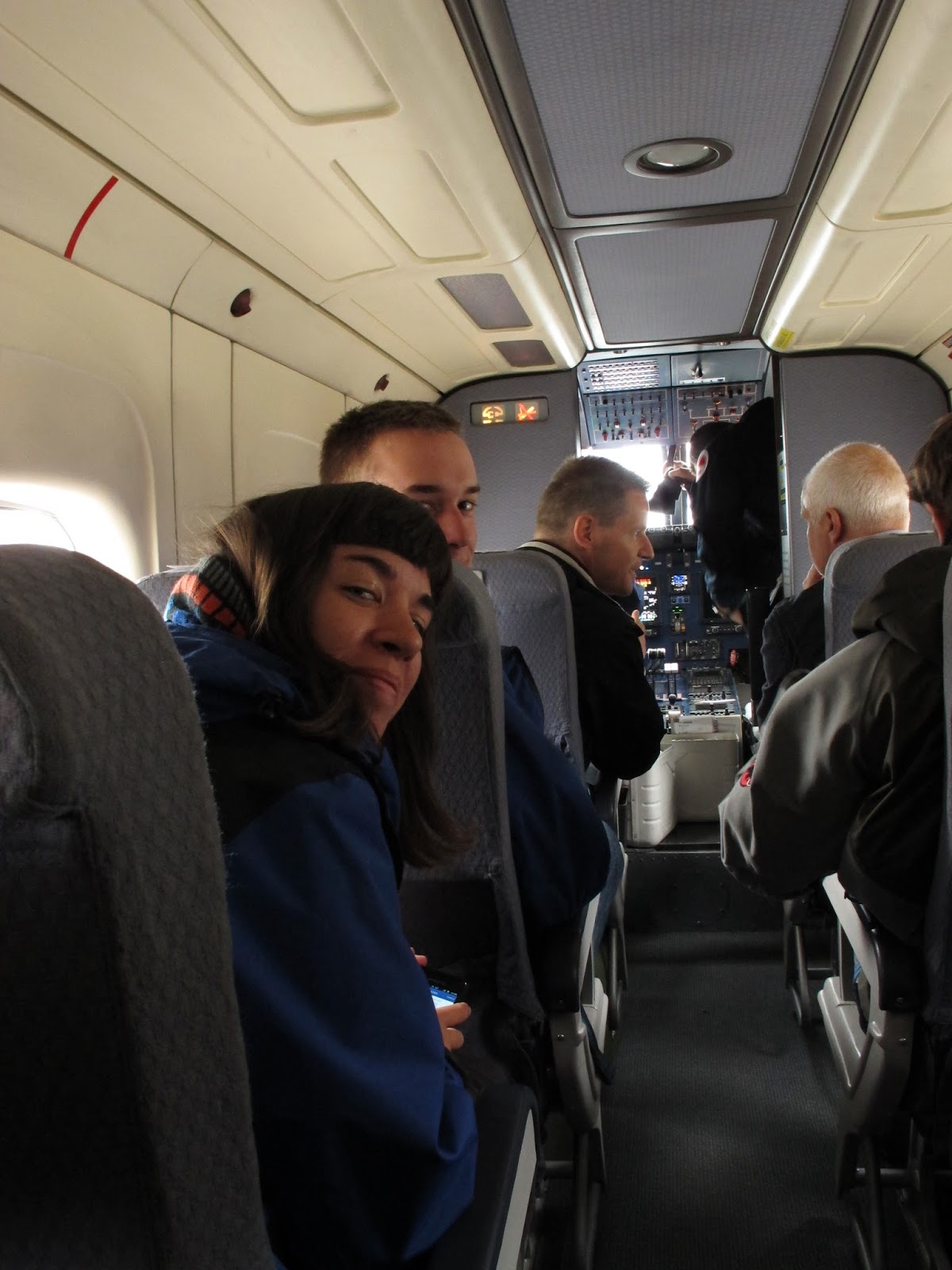
The flight to Svalbard requested one stop over in Oslo, Norway, where we spend a few hours waiting and discussing the film plan. On our flight to Svalbard Bas arranged that Ruben could shoot some footage of the cockpit, pilots and the first glimpse of the impressive snow-capped peaks of Svalbard.
 
Midnight sun
We arrived a little later than planned but safe and sound at the windy air strip of Longyearbyen at mid night. As we are a little later in the season than our expedition last year, most of the snow in Longyearbyen is already gone and the bare brown sides of the mountains are visible. The light was beautiful at night when we arrived at our guest house. Instead of a well-deserved bed, Bas and Ruben decided to immediately start filming the surroundings and spotted the first Svalbard reindeer and an Arctic fox.

A short night later we are now back at the airport for our final leg to the Dutch Arctic station at Ny-Ålesund. We are currently waiting for the low clouds to lift before the small Dornier can take off.


Ruben Kocx at work at midnight